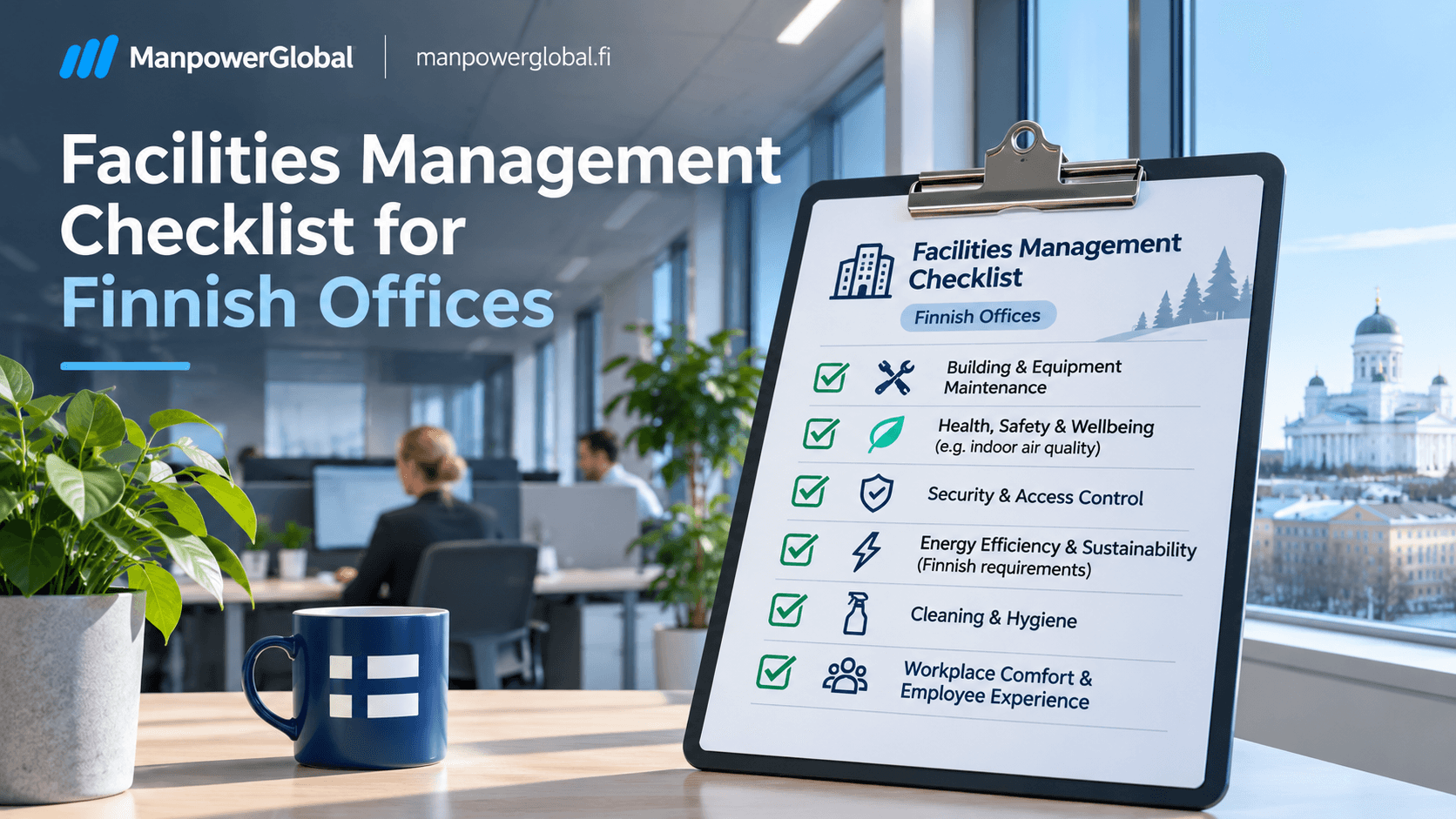
A Finnish office needs more than a list of routine maintenance tasks. Cleaning, heating, ventilation, access, outdoor areas and helpdesk arrangements all affect how well the workplace runs—and how quickly issues are addressed. A clear office facilities management checklist helps office managers see what is covered, who is responsible and what needs attention before conditions change.
Use the checklist below as a starting point for reviewing your property. Adapt it to the building, its use, your service agreements and any site-specific requirements. In autumn, for example, it is useful to check heating and ventilation arrangements, inspect entrances and walkways, and agree how snow and ice issues will be reported and handled.
Why facilities management checklists matter for Finnish offices
A checklist turns facilities management from a collection of separate tasks into a plan that can be reviewed. It gives office managers a way to check whether important work has an owner, a suitable schedule and a clear route for reporting problems.
This is particularly useful when a workplace relies on several suppliers or when building responsibilities are shared between an owner and a tenant. Without a common view, routine work can be missed, requests can be sent to the wrong contact, or assumptions about service scope can go untested.
A checklist can help you:
- Keep track of recurring cleaning and maintenance tasks.
- Identify issues that need attention before they disrupt the workplace.
- Clarify which party is responsible for each task.
- Give service providers useful information about access, priorities and site conditions.
- Review whether services still suit the number of occupants and how the office is used.
It is a planning aid, not a substitute for checking contracts or building-specific requirements. Confirm the applicable scope and responsibilities for your property rather than assuming that every office has the same arrangements.
What to review first
Start with the property and the people who use it. Before changing schedules or requesting additional services, establish what is already in place and where there are recurring problems.
Building use and occupant needs
Note which areas are occupied, how they are used and when they are busiest. Consider meeting rooms, kitchens, washrooms, reception areas, storage and any spaces with different access or cleaning needs. Ask occupants how they report issues and whether the current process is easy to use.
Current service scope
Gather the relevant service descriptions, contact details and schedules. Check which tasks are included, which are handled internally, and which require separate approval or a separate supplier. If the division of responsibilities is unclear, seek confirmation from the appropriate owner, tenant representative or service provider.
Building condition and recurring issues
Record known faults and repeat requests, such as temperature complaints, blocked routes, cleaning concerns or unreliable access arrangements. Distinguish urgent problems from routine improvements, and include enough detail for someone else to understand what needs checking.
For building systems, confirm who monitors and maintains them. Depending on the property and service scope, this may include HVAC services, heating system maintenance and indoor air quality support. A checklist should make the responsible contact and reporting route easy to find; it should not replace specialist assessment where one is needed.
Planning responsibilities and schedules
A useful checklist states what should happen, how often it should be reviewed and who follows up. The right schedule depends on the building, its use, the season and the agreed service scope, so avoid copying a generic timetable without checking whether it fits your site.
Organise tasks into practical groups:
- **Routine services:** cleaning, waste arrangements and checks of shared spaces.
- **Building systems:** planned maintenance, reported faults and follow-up for heating and ventilation.
- **Workplace support:** access to help, request handling and communication with occupants.
- **Outdoor areas:** entrances, paths, grounds and seasonal preparation.
- **Reviews:** service performance, open issues, upcoming work and changes in occupancy.
For each item, record an owner, a contact route and the next review point. Where a task depends on a supplier, note what information they need to act—for example, the location of the issue, access arrangements and whether the matter is time-sensitive.
Prepare for autumn and winter
Use October and November as a prompt to review winter readiness, adjusting the timing to local conditions and the property. Check that the approach to heating and ventilation is understood, that reported issues have a route to the right contact, and that entrances and walkways are included in outdoor-area planning.
Confirm how snow and ice concerns are raised, who assesses the situation and how updates are shared. Review the agreed scope for snow and ice management and grounds maintenance. Do not assume that a service covers every external area or every situation; confirm the details for the site.
Working with service providers
Good coordination starts with a shared understanding of the work. Give providers current information about the building, access procedures, operating hours and any areas that need particular attention. Agree how tasks are recorded, how concerns are escalated and who communicates updates to office occupants.
Review the services together when the workplace changes—for instance, if occupancy, opening hours or room use shifts. Cleaning needs may change with how spaces are used, so compare the agreed scope with real requirements for cleaning services. Likewise, make sure people know how to submit requests through the agreed helpdesk services, including what details to provide.
If several services need to work together, consider whether a coordinated Facilities Management approach would make responsibilities and communication easier to follow. Whatever the arrangement, keep a simple record of decisions, open actions and the person responsible for closing each one.
Common pitfalls to avoid
- **Using a generic checklist without adapting it.** A multi-tenant office, a small workplace and a building with extensive shared areas may need different checks.
- **Assuming a task is included.** Confirm service scope and contract responsibilities, particularly for outdoor areas, seasonal work and specialist maintenance.
- **Listing tasks without owners.** A task with no named role or reporting route is easy to overlook.
- **Treating reports as resolved when they are only logged.** Track actions through to confirmation or an agreed next step.
- **Separating occupant feedback from service reviews.** Recurring complaints can point to a mismatch between the agreed service and the way the office is used.
- **Waiting until winter conditions arrive to clarify arrangements.** Review access, communication and outdoor service plans ahead of seasonal changes.
- **Keeping the checklist somewhere people cannot find it.** Make the current version and key contacts accessible to the people who need them.
Facilities management checklist for Finnish offices
Use this list in a site review. Add local details, contacts and review dates, and mark any item that needs confirmation rather than assuming it is covered.
- **Property information:** Are the relevant areas, access points and shared spaces identified?
- **Responsibilities:** Is it clear what the owner, tenant, internal team and each provider handle?
- **Cleaning:** Do the schedule and scope reflect how the office is used? Is there a clear way to report missed or inadequate work?
- **Heating and ventilation:** Is the maintenance contact known? Is there a route for occupants to report comfort or system concerns?
- **Indoor conditions:** Are reports about indoor air quality directed to an appropriate contact for review?
- **Helpdesk and requests:** Do occupants know where to submit requests and what information to include? Is there a process for following up open issues?
- **Winter preparation:** Have heating, ventilation, entrances and outdoor-area arrangements been reviewed before seasonal conditions become a concern?
- **Snow and ice:** Is the scope for relevant external areas confirmed, and do people know how to report a concern?
- **Grounds and entrances:** Are outdoor areas included in the service plan, with responsibilities and access needs understood?
- **Provider coordination:** Are contacts, access arrangements and communication methods current?
- **Records and review:** Are recurring issues, decisions and follow-up actions recorded, with an owner and review point?
- **Changing needs:** Has the checklist been revisited after changes to occupancy, working patterns or use of the building?
Frequently asked questions
What does facilities management for a commercial office involve?
It involves coordinating the services and upkeep needed to support the building and its occupants. Depending on the property and agreed scope, this can include cleaning, building-system maintenance, helpdesk arrangements, outdoor-area services and communication between the people responsible. Confirm the exact responsibilities for your site.
How early should we plan facilities management for a Finnish office?
Review recurring services regularly and plan seasonal work ahead of the conditions it addresses. For winter preparation, an autumn review—often in October or November, depending on the site and local conditions—gives time to clarify responsibilities, contacts and service arrangements.
Who is responsible: the owner, tenant or service provider?
Responsibility depends on the property arrangements and service agreements. The owner, tenant, internal team and providers may have different roles. Check the relevant agreements and confirm any unclear responsibilities directly with the parties involved.
How do we get a quote or assessment for an office facilities management checklist?
Start by describing the property, the services you already use, recurring issues and the areas where responsibilities are unclear. Sharing this information helps a provider understand what should be reviewed. To discuss your site and next steps, request an FM review.
A practical checklist makes office services easier to coordinate, review and improve. Adapt it to your property, confirm responsibilities and revisit it as workplace needs and seasons change. If you would like help reviewing your arrangements, request an FM review.